Article

What to Do With Old Leads That Never Converted

June 30, 2026By Bor Cerlini
What to Do With Old Leads That Never Converted

The Short Version

Most home service contractors are sitting on a goldmine and don't even know it. It's the old leads buried in your CRM, the people who called or asked for a quote, then went cold. You already paid to get every one of them.

So what to do with old leads like that? You work them. A lead who already knows your name is far cheaper to reach and far likelier to book than a stranger off a paid ad. Most contractors never bother, because grinding a cold list by hand is miserable, so the goldmine just sits there.

This guide covers what to do with old leads, the real money hiding in your database, why text beats every other channel for working them, and how an AI agent can run the whole thing and book the jobs for you.

You don't have a lead problem. You have a follow-up problem.

Every contractor ends up with a pile of them. The leads that came in, showed some interest, and then never turned into a job.

Somebody called while you were up on a roof. Somebody filled out a form and you got back to them two days later. Somebody got a quote, said they'd think about it, and you never heard back. You meant to follow up. Then the next job, the next fire, the next week happened, and they slipped.

Do that for a couple of years and you're sitting on hundreds of them. Leads you paid good money to get, often a hundred bucks or more apiece, just sitting cold in your CRM.

Here's the good news. That pile is worth more than you think, and it has nothing to do with the leads being bad. The leads were fine. The follow-up just stopped.

The numbers back it up. It takes five to twelve touches to close most sales, and around 90% of contractors quit after one or two. The typical lead-to-job conversion rate across home services sits around 15 to 25%. The ones who push it to 35 to 50% don't get there by buying more leads. They get there by working the ones they already paid for.

So when you need more jobs next month, you've got two doors.

Door one: back out to the open market, outbid every competitor, and pay top dollar for a stranger who's never heard of you.

Door two: back to the hundreds of warm leads already in your pipeline who raised their hand once and already know your name.

Door two wins every time. Those leads are cheaper to reach, warmer, and already half-sold. The only reason they're not booked yet is that nobody followed up.

Comic-style illustration of a contractor staring at a CRM full of greyed-out old leads like tombstones, dull orange tones, money buried in an unworked lead list

What to do with old leads (the short answer: work them)

"Work them" sounds obvious, so let's be specific about what it means.

Your old leads fall into two buckets. The big one is dead leads. People who called, filled out a form, or got a quote, then went silent. They wanted the work. The timing slipped, or the follow-up did. The smaller bucket is past customers, people you've already done a job for who have another problem you could solve.

Reactivation works both, but the dead-lead pile is where the hidden money is, because almost nobody touches it. These aren't cold strangers. Every one of them already told you they have a problem you fix. Reaching back out to a warm lead who already knows your name costs a fraction of buying a brand-new one, and it converts far better, because you're not starting from "who are you," you're starting from "oh, right, you."

The message that works isn't "just checking in." It names the real thing. "Hey Dave, you reached out a few months back about a new AC, still want us to take a look before the summer rush?" Specific, human, easy to reply to. That's the whole move.

The money sitting in your CRM right now

Let's put a number on it, because most owners never have.

One roofing operator tracked his and posted it publicly. 404 estimates in a year, $14.8M in proposals out the door, 91 jobs closed for $1.38M. That's $13.48M in quoted work that didn't convert, in a single year. Most of those people didn't hire someone else that week. They stalled, and nobody followed up.

Now run it at your scale. Say you pull 100 leads a month and book 45 of them. That's solid. It also leaves 55 people every month who wanted help and never got booked, and that backlog has been piling up for years.

Reactivate it and even a modest hit rate changes your month. Book another 8 to 10 of those forgotten leads at a $6,000 average job, and that's real money.

$48,000 to $60,000.

From leads you'd already written off, with zero new ad spend.

That's the real lever on your lead-to-job conversion rate. Not more leads at the top. More booked out of the ones you already have.

Reactivation runs on any channel. Here's why text wins.

You can reactivate a list a few different ways, and they're not equal.

You can call them. Direct, but slow, and most people don't answer a number they don't recognize, so you burn the day in voicemail. You can mail them. A postcard works, but it costs real money and you wait days to hear anything. You can email them. Cheap, but it drops into a crowded inbox and most of it never gets opened.

Then there's text, and it wins for a simple reason. It's not as intrusive as a call, so it doesn't put people on the defensive, and it doesn't ask them to stop what they're doing and pick up. It's far more approachable than email, because a text actually gets seen. Almost everybody opens their texts.

That's the combination you want. With text you get reach and response at the same time. You can work a big list at once, because everyone sees the message, while still giving each person the space and time to reply when it suits them. No phone tag, no spam folder. Just a short, real message sitting on their phone until they're ready.

Doing it by hand vs handing it to an agent

You can run a first pass yourself. Pull your list, start texting, and you'll book jobs. The problem shows up at volume.

If you've got hundreds of old leads, every reply is a conversation. Texting back and forth with all of them, answering questions, nailing down a time, is a full-time job on its own. And the day you get slammed with real work, the follow-up stops again, which is exactly how these leads went cold the first time.

That's the case for handing it to an agent.

You give it the list of leads you never converted, and from there it runs the whole thing. It sends the first message in your voice. When someone replies, it carries the conversation, answers the usual questions, and books the job straight into your calendar. The entire back-and-forth that would eat your week, it just handles.

You don't sit there managing it. You wake up to appointments on the calendar that weren't there the night before, from leads you'd already given up on.

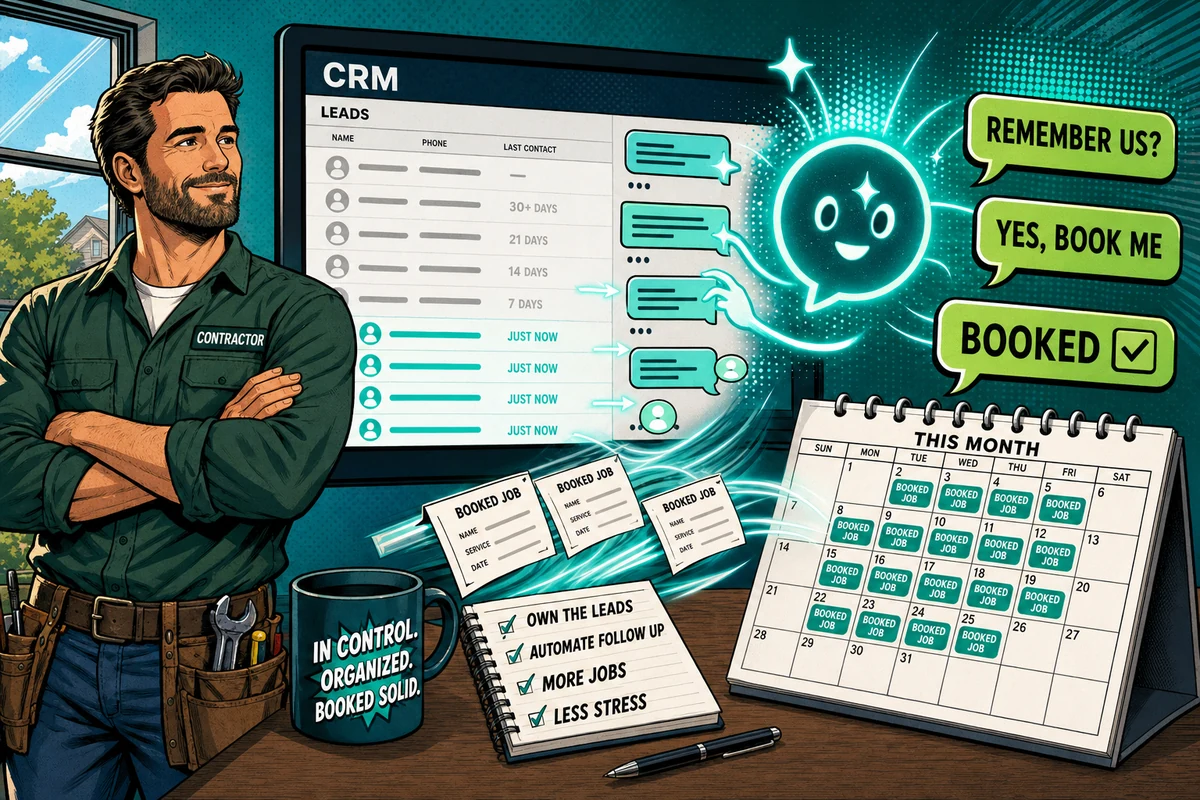
Comic-style illustration of an AI agent reviving a contractor old lead list, greyed-out leads lighting up teal, BOOKED notifications and a filling calendar

That's the next step once a quick first campaign proves the money is real. For a contractor with a big database, it's the difference between a list you'll never get around to working and a system that works it for you, on repeat, without anyone lifting a finger.

Where to start

Don't overthink the first move. Pull your list, grab the warmest slice, the leads from the last year who never booked, and send one simple text offering them the obvious next step. That single campaign almost always pays for itself, and it shows you the money is really there.

From there, the next level is letting an AI agent run the whole thing for you, every conversation and every booking, so you're not the one glued to your phone texting hundreds of people back.

If you want to see what that looks like for your business, start with a free mini-audit. We map where your leads come in, where they stall, and how much booked work is sitting dormant in your database right now, then point you at the one move that frees up the most money first.

You're one automation away,
Bor Cerlini

Frequently asked questions

What should I do with old leads that never converted?

Work them, don't write them off. Reach back out to the leads already in your CRM with a personalized text that names their original request, and book the ones whose timing is finally right. You already paid to get these people, so it's the cheapest source of jobs you have.

Why aren't my leads converting into jobs?

Usually it's not lead quality, it's follow-up. Most sales take five to twelve touches and most contractors quit after one or two, so the jobs are lost in the gap, not at the source. Fix the follow-up and your lead-to-job conversion rate climbs without spending another dollar on new leads.

How much can reactivating old leads actually make me?

More than most owners expect. If you book even 8 to 10 extra jobs a month off a backlog you'd written off, at a few thousand dollars each, that's tens of thousands in work you already paid to generate. The bigger and more ignored your list, the bigger the first payday.

Is it better to text, call, or email old leads?

Text, in most cases. Calls get ignored because people don't answer unknown numbers, and emails get buried in a crowded inbox. A text is less intrusive than a call and far more likely to be seen than an email, so you get reach and a high response rate at the same time while still giving people room to reply when it suits them.

Is it safe to text my old leads, or will it annoy them?

It's fine when it's done right. These people asked for your help once, so a short, relevant message that names their actual request reads as good follow-up, not spam. Honor every opt-out instantly, keep the volume sane, and message like a real business reaching out to people it has a real relationship with.

Can an AI agent really book the jobs for me?

Yes, that's the whole point of it. You hand over the list, and the agent sends the first text, carries the back-and-forth when people reply, and books the appointment straight onto your calendar, only pulling in a human when a conversation actually needs one.

Do I need a new CRM or new software to do this?

No. Reactivation works on top of the tools you already run. The leads live in your CRM or your phone, and an agent or a simple sequence can work them without you ripping anything out and starting over.

Written by Bor Cerlini