Speed to Lead for Contractors: Why the First 5 Minutes Decide the Job
May 4, 2026By Bor Cerlini
The Short Version
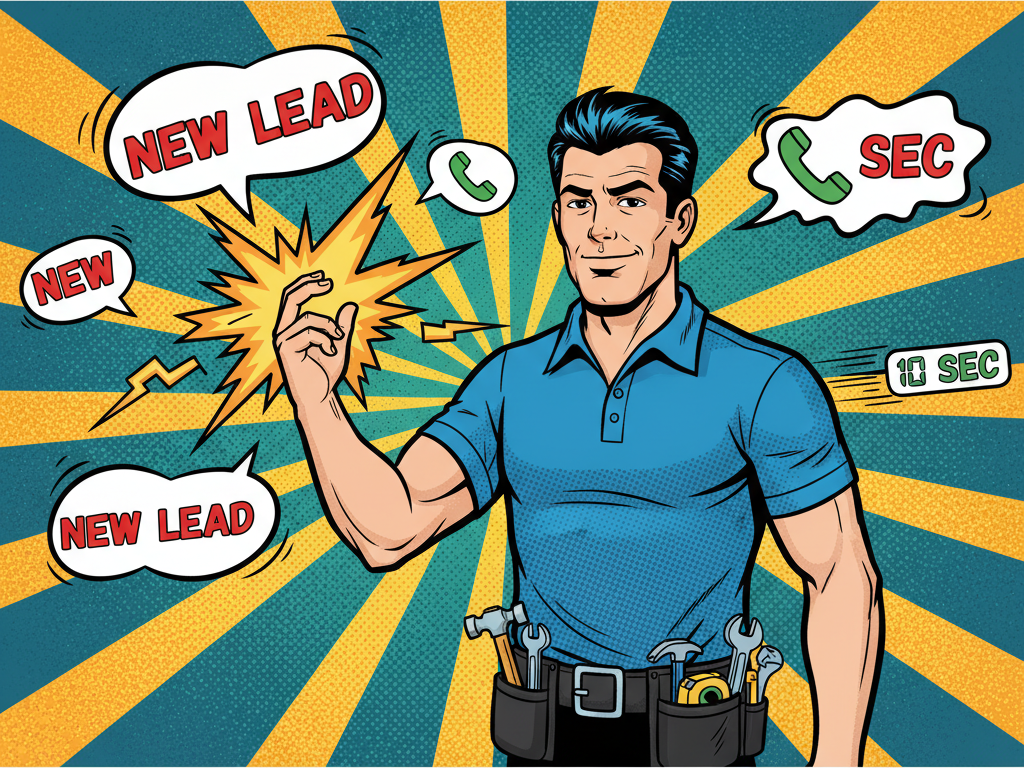
Speed to lead is the time between a lead reaching out and you (or your system) making first contact. It sounds like a small operational detail, but it's actually one of the biggest factors deciding which contractor wins the job.
Velocify analyzed 3.5 million leads and found that responding within 60 seconds produces 391% better conversion than waiting just two minutes. Two minutes. That's how thin the margin is.
For home service contractors, this is where most revenue quietly disappears. Not to contractors with better pricing. Not to ones with better reviews. Just to the ones who responded faster.
The good news is this is one of the easiest leaks to plug. Automated follow-up systems can close the gap to under 60 seconds without you hiring a single new person, and the lift in close rate often pays for the system many times over within the first month.
Below, we break down exactly how it works, why manual follow-up always breaks down at scale, and what separates speed to lead from the deeper concept most contractors are missing: speed to relationship.
Why Speed to Lead Actually Decides the Job
Have you ever felt like your leads are garbage?
You're spending $100, $150, $200 per lead and half of them won't even pick up the phone, let alone book an estimate with you.
So most of them end up sitting unresponsive in your pipeline.
If you can relate to this and you have a bunch of unrealized opportunities sitting cold in your CRM graveyard…
Opportunities that could represent an additional 6 maybe even 7 figures for your company…
Then this post is for you.
The fact is that in today's competitive market where more and more home service pros are competing for the same leads…
It's inevitable that you're sharing leads with four other contractors who got the same info at the same time.
Most homeowners, when they decide to do some work on their home, reach out to more contractors and not just one.
Why?
One reason is definitely to compare different prices.
But perhaps the even more important reason is that they're used to not getting responses to their inquiries.
That's just the nature of the industry.
So what actually decides who gets the job?
Well, there are a lot of different factors but according to research (and my experience), one of the biggest ones is…
Speed.
Research from InsideSales, later cited in a Harvard Business Review analysis, found that leads contacted within 5 minutes are 21x more likely to qualify than leads contacted after 30 minutes.
After an hour, you're fighting significant odds.
After a business day, you're essentially starting from zero.
And this is just the beginning…
Velocify analyzed roughly 3.5 million leads and found that calling a lead within 60 seconds produces 391% better conversion compared to waiting just two minutes.
The bottom line is…
The window where speed actually matters is measured in seconds, not hours.
And to make this real, let me paint you a picture…
A homeowner fills out a quote form on your website at 2:14pm on a Tuesday.
They also fill out forms for two other contractors on the same page of Google results. Because that's what people do.
At 2:17pm, one of those contractors sends a text: "Hey, this is Jake from Summit Roofing, got your request, happy to get you a quote. When's a good time to talk?"
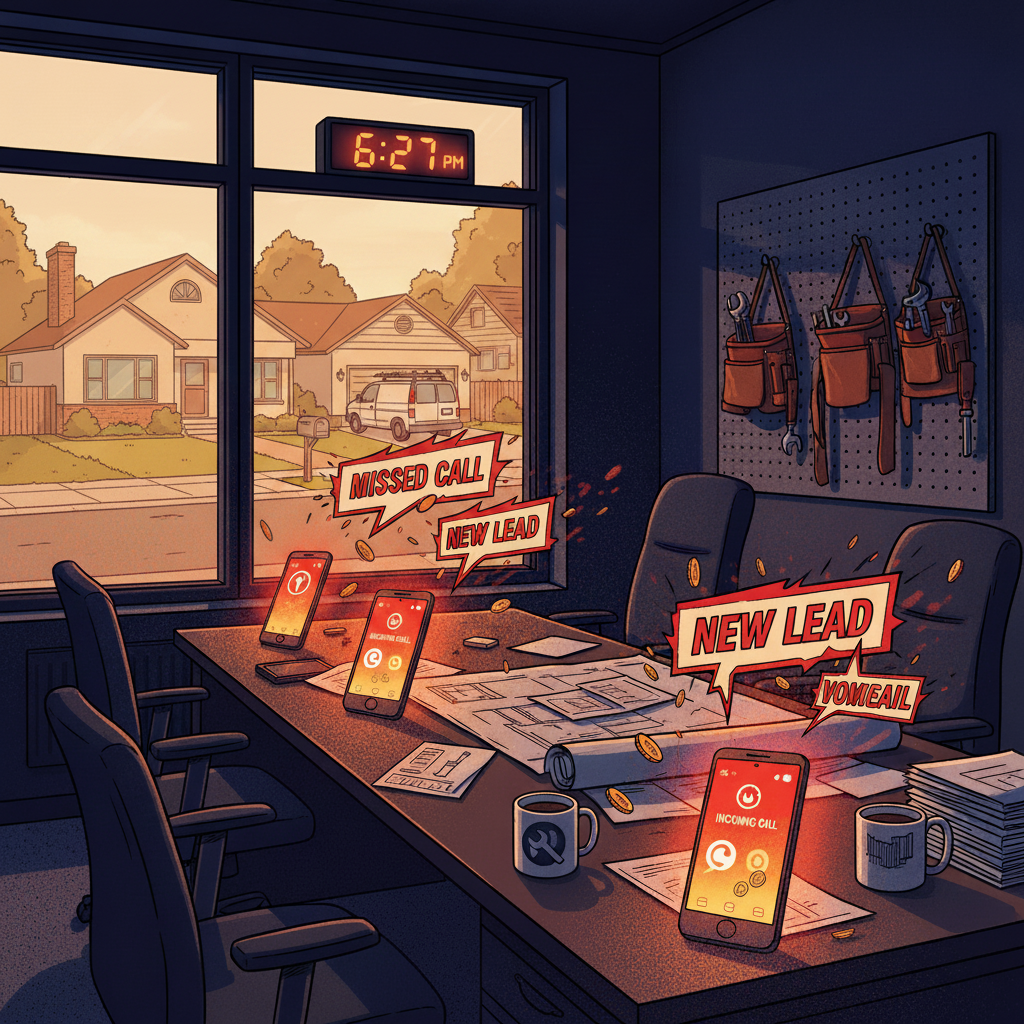
At 4:30pm, you call. Goes to voicemail. You leave one. They never call back.
You didn't lose that job because your price was wrong, or your reviews were worse, or your crew isn't as good.
You lost it because Jake responded in three minutes and you responded in two hours and sixteen minutes.
By the time you called, the relationship already existed. Just not with you.
This is what speed to lead actually means in the home service world.
It's not just a marketing metric. It's the window between someone raising their hand and someone else closing it for you.
The Math Most Contractors Never Run
You can run the math on your own operation.
Say you generate 100 leads a month and your average job value is $5,500.
If your current response time averages 45 minutes, you're operating well outside the window where leads are still warm.
At a 22% close rate on those 100 leads, you're booking 22 jobs. Around $121,000 a month.
Now assume automated first contact brings your effective response time under 60 seconds for every lead, every time, including evenings and weekends when your office is closed.
Close rate moves to 30%, which is conservative based on what we've seen with clients like Solarcek, who went from a 29% to a 47% close rate after implementing a full follow-up system.
That's 30 booked jobs instead of 22. On the same 100 leads. With zero additional ad spend.
You suddenly unlock an additional $44,000 a month.
Out of the blue.
And this isn't coming from better marketing. It's coming from not letting the lead go cold before you call.
Now imagine what an even bigger jump in conversions would mean for your business…
We're talking about a potential 6-figure lift every single month.
Or in other words…
7 figures annually.
What Kills Response Speed (And Why It's Not Your Team's Fault)
Here's the thing. The reason most contractors respond slowly isn't laziness. It's physics.
When a lead comes in at 11:30am, you might be on a job site. Your office manager might be handling a scheduling conflict.
The notification comes through, gets mentally filed under "I'll get to that this afternoon," and by 3pm it's buried under six other things.
This is the Operational Tax.
A tax that has nothing to do with the government and that never shows up on your P&L.
Yet you're paying it every single day. In every lead that went cold before anyone followed up. Every quote sitting in someone's inbox with no follow-through. Every cancelled appointment because nobody kept that relationship warm.
The chaos is structural, not personal.
Manual follow-up breaks down because response requires human attention at a moment when human attention is elsewhere.
Because even if you have people working specifically on this, it's inevitable that they'll still miss some.
They're just humans running at capacity… juggling calls, managing their workload, dealing with hundreds of leads and making judgment calls under pressure all day long.
They simply can't keep track of every single opportunity in your pipeline and consistently follow up with them.
And this is exactly why speed to lead matters so much.
It's the single biggest lever you can pull right now to stop bleeding revenue.
Because when every lead gets contacted in seconds instead of hours, the leads you thought were garbage start looking very different.
The ones you're paying $150-$200 to generate?
Suddenly they start converting at rates that make your ad spend look like a bargain.
And the "tire-kickers" your team complains about?
Half of them turn into real conversations the moment someone reaches them in the first 60 seconds.
But…
Just being fast on that first response isn't the full picture anymore.
There's a deeper layer to this most people are still missing.
And that's exactly what we're going to talk about next…
Speed to Lead vs. Speed to Relationship
We talked about speed to lead.
But truth to be told, this is what everybody is talking about.
And more and more companies are starting to use it because theyre realizing how crucial it is for their conversions.
But here's the thing nobody's talking about…
Because of that speed to lead is now table stakes.
It's not your competitive advantage anymore.
It's the bare minimum to even stay in the game.
Think about it…
If everybody is using speed-to-lead automation now, how do you actually stand out?
If 2 companies both reach out to a lead immediately… which one wins?
The answer is actually quite simple:
The one that responds faster to the second message. And the third. And the fourth.
It's not just speed to lead anymore.
It's speed to relationship.
And this is where most contractors fall short.
Their automation sends that first text instantly… (great)
But when the lead replies?
Someone on the team has to manually respond.
Which means delays, missed messages and leads going cold while your team is not available.
If you have a text back set up that is being sent to your leads within 60 seconds but you don't respond and continue the conversation if they come back to you…
It's almost like not having speed to lead at all.
People will still forget about your initial response and go search for someone else.
And that's where AI changes everything.
With AI built into your follow-up…
Every reply is instant.
Every question gets answered.
Every lead gets nurtured.
24/7. No gaps. No delays.
And here's the best part…
Most contractors still aren't using AI for that.
Which means this can be your competitive advantage if you decide to embrace it now.
You can leapfrog the entire market with AI-powered conversations that never miss a beat.
And while your competitors are still manually typing responses…
You're already 5 messages ahead, building rapport, and booking estimates.
Speed gets you in the room. Relationship keeps you in it.
"We're no longer losing jobs because we replied too late."
- Solarcek (exterior cleaning, 29% to 47% close rate)
How to Fix Speed to Lead Without Hiring More People
The fix isn't hiring more people.
It's by building a system that responds before any human has to (and before your competitors can).
Speed to lead, when we're talking about it correctly, means this: a homeowner requests your services through any inbound channel, whether that's a Google ad form, a Facebook ad, Thumbtack, Angi, or your website. The clock starts the second they hit submit. Everything below is about what happens in those first seconds.
There are three practical layers to a functional speed-to-lead setup:
Layer 1: Immediate Inbound Response
The moment a form fills out, an automated text fires within seconds. Something like:
"Hey [Name], got your request. We'll be calling you shortly. But if you'd rather sort everything out by text, just reply here and we'll get it done."
That message does two things at once. It confirms to the lead that they've been heard, which immediately separates you from every competitor who went silent. And it opens a text thread before they've had a chance to move on.
Think about what this feels like from their side. They're still on your page, or maybe just clicked away to check a competitor's site, and their phone buzzes. That's the moment. That's when you have their full attention and they're still thinking about you.
Layer 2: AI Chatbot Follow-Through
If the lead replies to that first text, a human needs to be ready. Except they won't be. That's the whole problem.
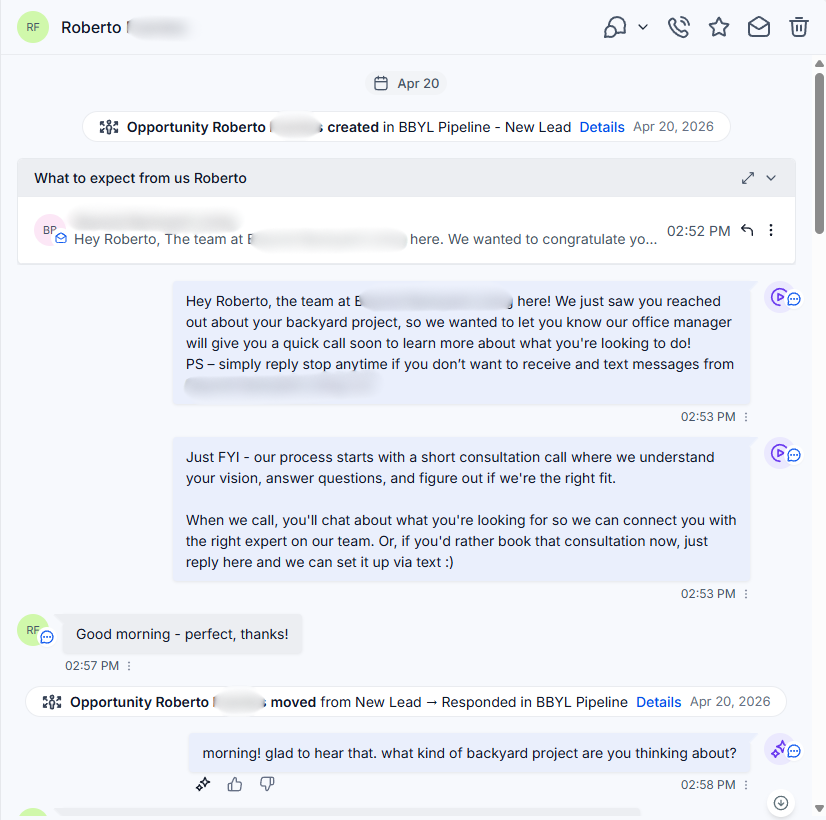
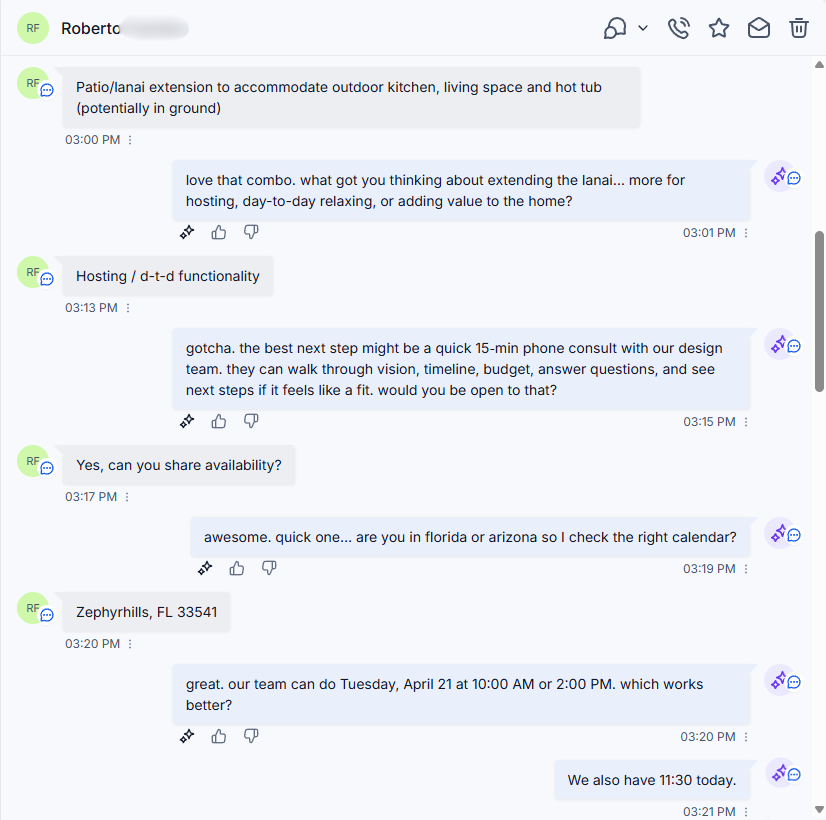
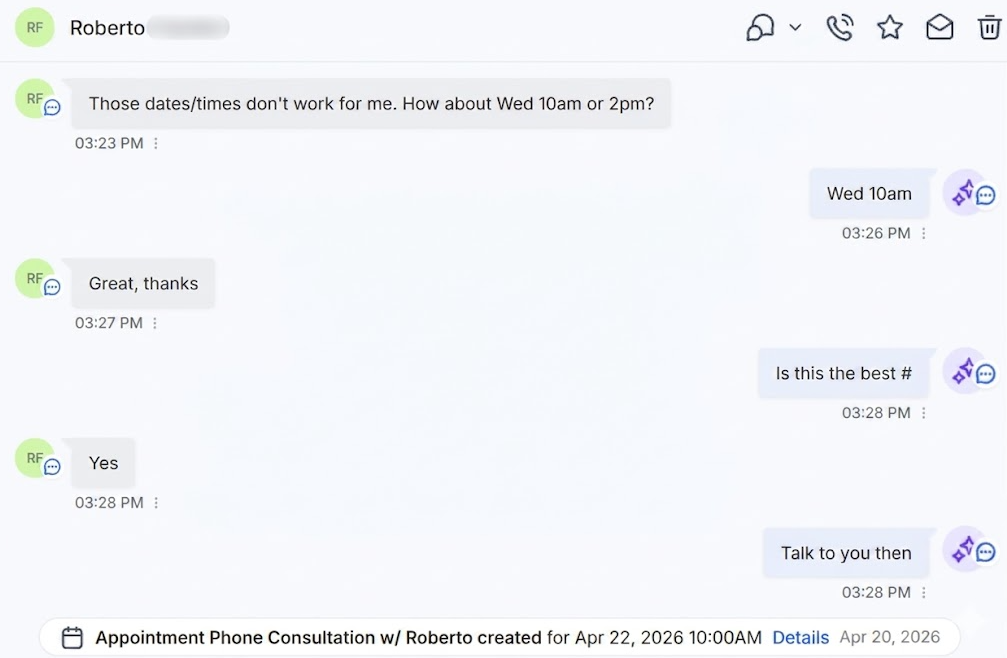
So the AI chatbot takes over. It handles the back-and-forth in real time, asks qualifying questions, figures out the scope of work, and pushes toward booking an appointment. All without a human in the loop.
The lead never hits a dead end. They send a message and they get a response. That continuity is what converts interest into a booked call.
This might look like this (real example from one of our clients) 👇
Layer 3: Outbound AI Voice Agent
And for contractors who want to go further, an outbound AI voice agent can call the lead within seconds of the form filling out. It handles the qualification call directly, collects job details, and can initiate scheduling into the CRM.
For late-night leads where an immediate call might catch someone off guard, the system can send a quick SMS first: "We got your request. Are you open to a quick call right now?" If they say yes, the agent can call immediately. Even at midnight.
This is the layer that turns speed to lead into a round-the-clock operation. No human sitting by the phone. No leads sitting cold until morning.
Note: having a human call immediately when the lead comes in is still best. Humans (at least for now) still outperform AI, and it's just better overall to have that human first point of contact. But if you're not calling your leads for hours or even days after they inquire about your services, you might want to think about leveraging AI like this because it can be a game-changer for your conversions.
Feature
Manual follow-up
Automated first contact
Response time
60+ minutes (typical)
Under 60 seconds
Evenings and weekends
Not covered
24/7, every lead
Lead qualification
Only when someone is available
Real-time text conversation
Message consistency
Varies by who answers
Built once, deployed always
Cost
Full time salary +
Fraction of that
If you're interested in learning more about our foundational automation system and how it can help you book more jobs from the leads you're already getting…
You can find our free guide at the link below.
Inside, I break down the 5 automations that help contractors just like you plug those revenue leaks…
… so you can stop leaving money on the table and start converting more of the leads you're already getting 👇
What is speed to lead and why does it matter for contractors?
Speed to lead is the time between receiving an inbound lead and making first contact. For contractors, it matters because home service decisions move fast. Homeowners typically contact multiple businesses at once and choose whoever responds first. Research shows leads contacted within 5 minutes are 21x more likely to qualify than those reached after 30 minutes. Velocify data on 3.5 million leads shows the difference between calling within 60 seconds versus waiting just two minutes is a 391% difference in conversion. Most contractors operating active crews respond in 60+ minutes by default, which puts them well outside the window where leads are still warm.
How fast should a contractor respond to a new lead?
Under 60 seconds is the target, and it's achievable with the right automation. The key is that this response doesn't have to come from a human. An automated text that sounds personal and opens a conversation handles the critical first touchpoint while the contractor is on a job site. A human follows up once the lead has responded and is engaged.
Can automated responses actually book jobs, or do they just stall?
When written well, automated first-touch messages regularly generate replies that progress toward booked appointments, especially when they ask a qualifying question rather than just confirming receipt. The best-performing first messages are short, personal in tone, and invite a response. They don't pitch. They open. An AI text agent can then handle the back-and-forth in real time, qualify the lead, and push toward booking before any human is involved.
What happens to leads that come in after hours?
Without a system, after-hours leads typically sit until the next business day, by which point many have already decided. With an automated SMS sequence and outbound AI voice agent, after-hours leads get contacted within 60 seconds, 24/7. The system can send a consent SMS first for late-night leads, then call immediately if they say yes. Even a well-written automated text sent at 10pm that opens a conversation is significantly more effective than a callback at 9am the next morning.
What's the difference between speed to lead and speed to relationship?
Speed to lead is the clock on your first response. The seconds between the lead submitting their info and your first message hitting their phone. Speed to relationship is what happens after that. When the lead replies with a question, an objection, or a request for more info, how fast does someone respond? Most contractors nail the first message with a text-back automation but then go silent for hours when the conversation actually starts. That's where the relationship dies. Speed to relationship is having every reply answered instantly, every question handled in real time, and the conversation moving forward 24/7. The first message gets you noticed. The ongoing conversation is what books the job.
Does speed to lead apply to shared lead platforms like Angi or Thumbtack?
It applies even more. Shared leads go to multiple contractors simultaneously, which means response speed is the primary competitive differentiator, not price, reviews, or experience. Contractors who respond within 30 seconds on shared lead platforms routinely outperform contractors with better profiles who respond in 10 minutes. Speed to lead on shared platforms is not an advantage. It's the minimum requirement for having a real shot at the job.