Article

5 AI Agents That Actually Move the Needle for Home Service Contractors in 2026

June 28, 2026By Bor Cerlini
5 AI agents for home service companies hero image

The Short Version

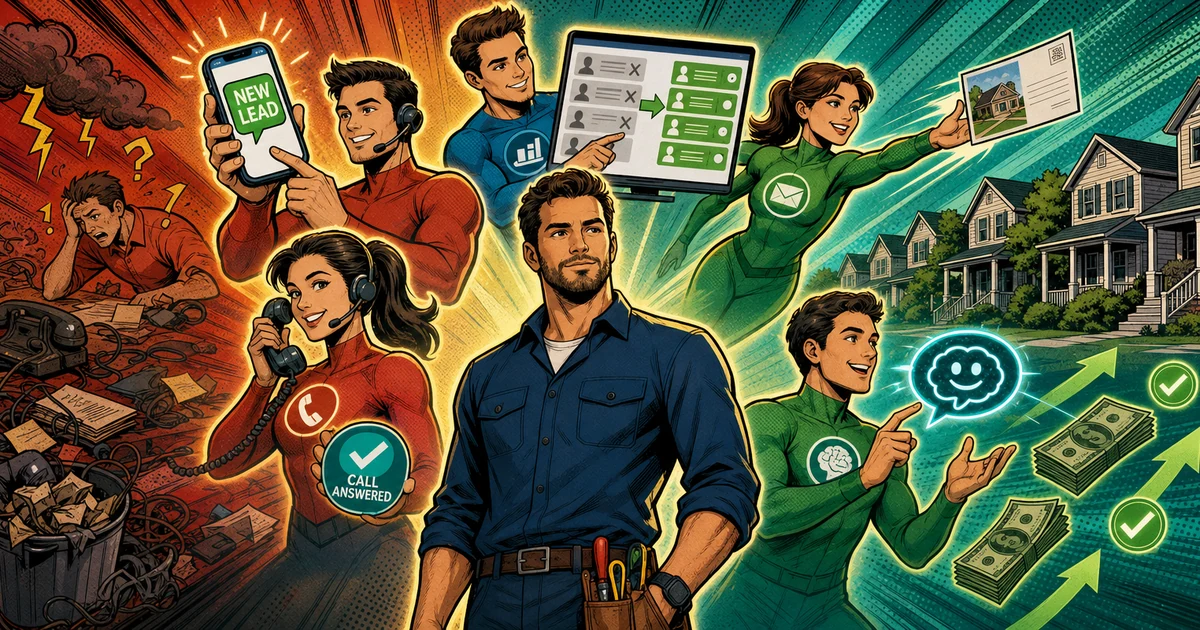
AI agents for home service companies are everywhere in 2026, and most of it is hype. The contractors pulling ahead aren't betting on "AI" as one big thing. They're running a few specific agents that each do one job well, and stacking them.

This guide breaks down the five that actually move the needle. The Speed-to-Lead Agent texts every new lead in under a minute. The AI Voice Agent answers the calls you'd otherwise miss, day or night. The Reactivation Agent works your old customer list for booked jobs. The Neighborhood Agent turns one finished job into the next three on the same street. And the Knowledge Base Agent puts your whole company playbook one question away for every person on your team.

For each one you get what it does, why it matters at a real operator's scale, and how a home service business actually puts it to work.

What's actually keeping your home service business from running without you?

Be honest for a second. What's the real reason your company still needs you in the loop on almost everything?

It isn't your crews. It isn't your trucks. It isn't even your lead flow.

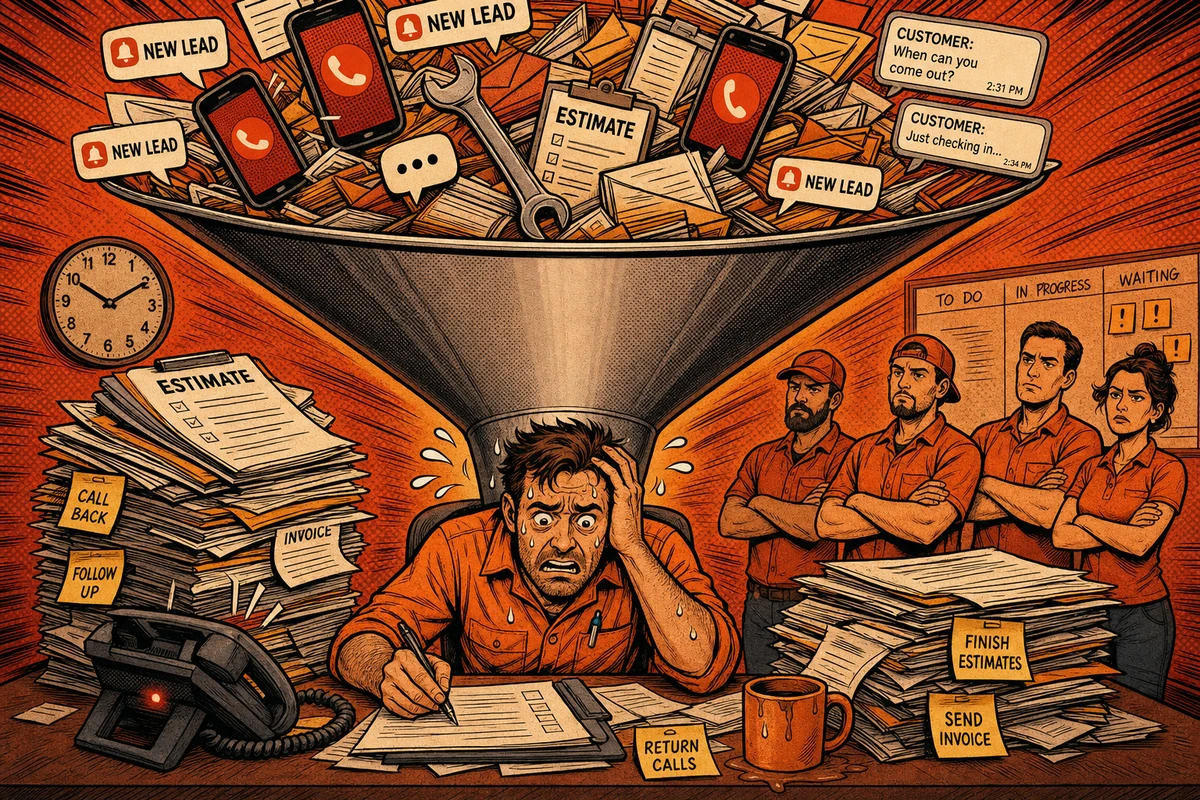
It's that too much of the business still lives in your head, or only happens when you personally push it. You're the one who calls back the lead that slipped through. You're the one who knows the pricing exception. You're the one who remembers to ask for the review three days after the job wraps.

That's a systems problem wearing a staffing problem's clothes. And it's exactly the kind of thing this new wave of AI agents was built to fix.

So here's the question every operator is quietly asking right now... which AI actually earns its keep, and which is just noise?

The honest answer comes down to a handful of agents. Five, specifically.

And the timing matters more than most people realize. ServiceTitan's 2026 Residential State of the Trades report found only about 25% of contractors are using AI in any real way, while close to half still don't trust it. Most of your market is on the sidelines. The operators moving now are buying a head start their competitors will spend years trying to close.

Here's what most "AI for contractors" guides get wrong. They sell you the flashy, futuristic stuff. The agents that actually move money are almost boring, each one does a single job, and does it every time without you touching it.

These are the five worth your attention.

Comic-style illustration of an overwhelmed home service contractor as the bottleneck of his business, with calls, leads, and paperwork funneling through him while his crew waits

Agent 1: The Speed-to-Lead Agent (your 60-second first responder)

What it does

The second a lead comes in, from a form, a Google or Facebook ad, or your website, the Speed-to-Lead Agent fires back a text. Not in an hour. In seconds. It opens the conversation, asks the qualifying questions, and pushes toward a booked appointment, all before your competitor has even seen the lead.

Why it moves the needle

This is the most revenue-correlated agent on the list, and it isn't close.

The research that started it all, from InsideSales and cited in Harvard Business Review, found that contacting a lead within five minutes makes you 21 times more likely to qualify them than waiting just 30 minutes. More recent 2026 data is even starker: leads answered inside five minutes convert to opportunities at 21%, versus 2.3% for the ones you get to after 24 hours.

Now here's the part that should make you angry. A RevenueHero study of 1,000 companies found 63.5% never responded to their leads at all, and the ones who did averaged over 29 hours. The median B2B response time across a 2026 study of 253,817 leads was 42 hours.

Forty-two hours. On a lead you paid for.

That gap is where your ad budget quietly dies. And it's the exact gap an agent closes for good, because it never sleeps, never gets busy on a job site, and never forgets to follow up.

One of my solar clients, Solarcek, had real crews and a real sales process. Their close rate still sat at 29%. We plugged in AI-driven follow-up that hit every new lead in under two minutes, and the close rate climbed to 47% over five months. Same leads. Different speed.

How an operator runs it

You connect the agent to every place a lead can come from, then it texts back in under a minute, qualifies on autopilot, and drops booked jobs straight onto the calendar. The hot ones it hands to a human while they're still warm. The rest it keeps nurturing so they never go cold in the first place.
Agent 2: The AI Voice Agent (it answers the calls you'd otherwise miss)

What it does

The AI Voice Agent picks up the phone. Every time. It sounds human, it answers the questions homeowners actually ask, it books the appointment, and it flags a real emergency for a person. After hours, on a Sunday, during the lunch rush when all three lines are ringing, it's there.

Why it moves the needle

Most contractors have no idea how many calls they're dropping. The number is brutal. One analysis of 130,175 calls across 45 contractors found 74.1% went unanswered during normal business hours.

Let me put that in money, at a real operator's scale.

Say your average job is worth $5,000 and you miss just 10 calls a week. CallbirdAI's 2026 survey of 1,200 home service contractors pegs that loss at $45,000 to $120,000 a year. Invoca's 2026 data values a single missed call at roughly $1,200. And 85% of the people who hit your voicemail never call back.

$1,200 a call.

Ten calls a week gone.

Six figures a year, walking straight to the contractor who picked up.

It gets worse after dark. Nearly 35% of after-hours callers are ready to buy, and almost nobody is staffed to catch them. A voice agent trained on your service area, your pricing rules, and your dispatch logic can recover an estimated 60 to 80% of that lost revenue.

The reaction from homeowners is usually the same. "Oh, you actually picked up. I didn't expect that." That little moment of surprise is you winning the job before the pitch even starts.

How an operator runs it

Calls forward to the agent when nobody answers or when the office is closed. It greets the caller in your company's voice, handles the routine stuff, books what it can, and texts a human the second something needs a person. You wake up to booked jobs instead of a voicemail box full of people who already hired someone else.

Agent 3: The Reactivation Agent (it mines your dead CRM for booked jobs)

What it does

Every contractor is sitting on a goldmine and treating it like a junk drawer. The Reactivation Agent works your old database, past customers and dead leads, with personalized text and email, and books the ones whose timing is finally right.

Why it moves the needle

The average contractor has 500 or more past customers sitting dormant in a CRM, a phone, or some accounting software. Industry estimates put that at $50,000 to $250,000 in untapped repeat and referral revenue, every year, that you already paid to acquire.

The economics are nothing like cold leads. Reactivated contacts convert at 10 to 25%, against 3 to 8% for cold. Every dollar spent tends to return somewhere between $10 and $50, because you're not buying trust, you already earned it. The only real question with an old customer is timing, not whether they know you.

And it's fast. Most contractors see booked jobs in the first week, with the campaign paying for itself inside 30 days.

This was a big piece of the Solarcek turnaround too. The leads were always there. The follow-up wasn't. An agent fixes the part that was missing without adding a single hour to anyone's week.

How an operator runs it

You hand the agent your list and it segments it, then sends messages written in your voice that name the actual service you did ("it's been about a year since we tuned up your AC, want us to get you on the schedule before the heat hits?"). Replies route to the right place, jobs land on the calendar, and the database finally pays you back.

Agent 4: The Neighborhood Agent (it turns one finished job into the next three)

What it does

The minute a job closes, the Neighborhood Agent takes the addresses around it and mails the neighbors a postcard. Not a generic flyer. A personalized one, with a picture of their own house on it, and a line that's simply true: "we just finished a project two doors down on your street."

You don't have the neighbors' phone numbers or emails, and you don't need them. You have their addresses, so this one goes by mail, and a postcard with someone's own home on the front is almost impossible to toss unread.

Why it moves the needle

The warmest lead in home services isn't online. It's the neighbor who watched your truck sit on the block all afternoon and your crew do clean, professional work.

They've already seen the proof. They've maybe been meaning to handle the same thing. And roofs, driveways, fences, and paint jobs tend to age at the same rate up and down a street, so when one house finally does it, the others are closer to ready than they look.

Most contractors leave that money on the table because nobody has time to map the neighbors and design a custom mailer after every job. An agent does it automatically, the same day, while your work is still the freshest thing on the street.

This one is a heavier build than the first three, and it's newer, so treat it as the next move rather than the first. But for a company doing real volume, turning each completed job into a small local campaign compounds fast.

How an operator runs it

The agent triggers when a job is marked complete, pulls the surrounding addresses, and grabs a photo of each home from the map data. Then it designs a personalized postcard for each one, adds a QR code that points to a short landing page for that exact street, queues the mailing, and tracks who scans. Your finished jobs stop being endpoints and become the top of the next funnel.

Agent 5: The Knowledge Base Agent (the company brain your whole team can talk to)

What it does

This is the one almost nobody is running yet, and it's the one I'd bet on hardest.

The Knowledge Base Agent lives inside the tools your team already uses, your CRM, a chat window, a Slack channel, and it holds everything about how your company actually runs. Anyone on the team can ask it anything and get the right answer in seconds.

"What's our warranty on exterior painting jobs?" "Do we service the 94501 zip?" "What do we say when a homeowner pushes back on price?" "What's the step-by-step for a duct cleaning on a two-story?"

It answers in your company's actual words, not a generic chatbot's guess.

Why it moves the needle

Go back to the question this whole guide opened with. Why does the business still need you in the loop on everything?

Because the knowledge lives in your head, and in the heads of two or three veterans who are always the ones getting interrupted. New hires take months to get useful. The same questions get asked a hundred times. And when you're up on a roof or out on a quote, the whole operation slows to the speed of "let me check with the boss."

A Knowledge Base Agent breaks that. The answer is the same whether you're reachable or not. A new tech ramps in days instead of months. Your best people stop being a help desk and get their day back. And the thing you've been quietly afraid of, that the business can't run without you, stops being true.

That's why I think this is the real edge for 2026. The first four agents win you more jobs. This one finally gets you out of the bottleneck.

How an operator runs it

You feed it the stuff that's currently trapped in your head and your files: your SOPs, pricing rules, sales scripts, warranty terms, service area, the answers to the questions your team asks you on repeat. It lives where your people already work, and it gets smarter every time you add to it.

One agent is a gimmick. A stack that shares a brain is a system.

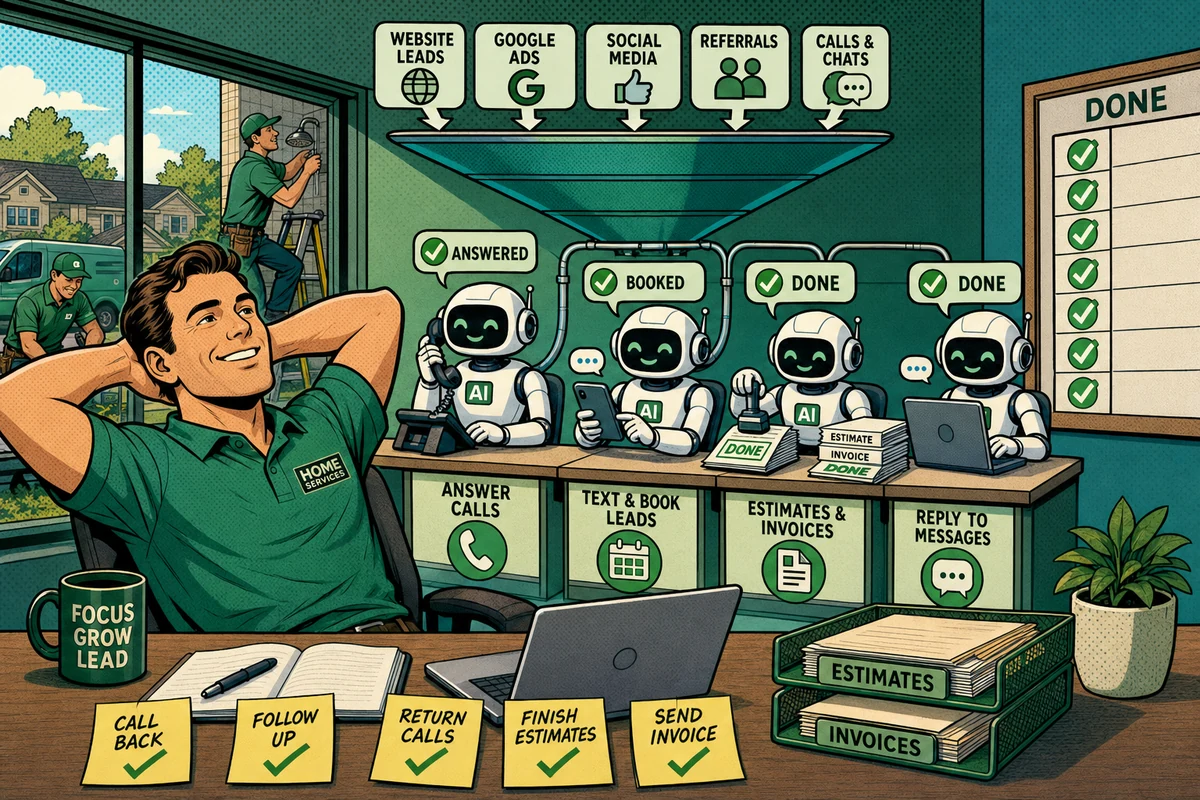
Comic-style illustration of a calm home service contractor while AI agents handle his calls, leads, estimates, and customers and the work gets done

Here's where most contractors get AI wrong, and it's probably why half of them don't trust it yet.

They bolt on one disconnected bot, it does one thing in a vacuum, and it just becomes the ninth disconnected tool in a stack that already wasn't talking to itself. More chaos, not less.

The agents have to share context. Your Speed-to-Lead Agent should know what your Voice Agent already told that caller. Your Reactivation Agent should know who just booked so it stops texting them. When the agents run on one shared brain, they stop being a pile of tools and start being a system that runs your front office.

This is also the difference between speed-to-lead and what I call speed-to-relationship. Answering fast gets you in the door. But the contractor who wins is the one whose whole follow-up, booking, and customer experience feels like one fast, organized company instead of five bots tripping over each other.

Where to start (you don't need all five at once)

Trying to deploy all five in week one is how operators burn out and quit on the whole idea. Don't.

Start with the leak that's costing you the most. For most contractors that's speed-to-lead or missed calls, because both bleed money you can actually see. Pick one, get it live, and prove it in booked jobs inside 30 days. Then stack the next one on top.

If you're not sure which leak is biggest, that's worth figuring out before you spend a dollar on tools. A quick audit of where your leads come in, where they stall, and where they die will usually point straight at the agent you should build first. We put together a free mini-audit that maps exactly that, one pain point and one opportunity, so you can see your biggest leak before you commit to fixing it.

You're one automation away,
Bor Cerlini

Frequently asked questions

Do I have to replace my CRM to use these AI agents?

No. Good agents sit on top of the tools you already run. The whole point is to make your current stack work harder, not to make you rip it out and start over.

Will customers be able to tell it's AI, and will it sound robotic?

The 2026 voice agents are good enough that most callers can't tell, and the data backs it up: across a sample of nearly 1.5 million business calls, 99% of callers expressed positive or neutral sentiment toward AI interactions. The agent is trained on your voice and your information, so it sounds like your company, not a generic phone tree.

How fast do AI agents actually pay off for a home service business?

Faster than most tools you've bought. A reactivation campaign often books jobs in the first week and pays for itself within 30 days. A speed-to-lead or voice agent starts catching revenue the day it goes live, because the leaks it plugs are happening right now.

Which agent should I deploy first?

Whichever one stops the biggest leak. For most contractors that's the Speed-to-Lead Agent or the AI Voice Agent, since missed calls and slow follow-up are where the most obvious money is walking out the door. Start there, prove it, then build the next one.

Is it safe to text my old customer list like that?

It is when it's done right. Messaging people who are already your customers, in your own voice, about a service you actually performed, is a different world from cold spam. The agent should respect opt-outs and send like a real business reaching out to people it has a real relationship with.

How much do AI agents for home service companies cost?

It depends on which agents you run and how much they handle, so any flat number you see online is mostly noise. The smarter way to think about it is leak versus fix: figure out what one missed-call or slow-follow-up leak is costing you per month first, then the math on plugging it tends to make itself.

Can these agents work together, or is it one at a time?

They work best together, as long as they share context. Five agents running on one brain behave like a coordinated front office. Five disconnected bots just add noise. Build them to talk to each other and the whole thing compounds.

Written by Bor Cerlini